Tuesday, July 24, 2012

Death Is Not an Option, How You Die Is


   Reflections From a Career in Oncology Nursing
Brenda M. Nevidjon, MSN, RN, FAAN; Deborah K. Mayer, PhD, RN, AOCN, FAAN
Posted: 07/20/2012; Nurs Econ. 2012;30(3):148-152. © 2012 Jannetti Publications, Inc.

Abstract and Introduction

Introduction

During the height of the Affordable Care Act (Strokoff & Grossman, 2010) debate, an editorial cartoon symbolized the perspectives on endof- life choices, with a humorous twist (see Figure 1). Headlines of "death panels" dominated the news for a while, but unfortunately, did not lead to a national conversation on end-of-life care. The purpose of this article is to reflect on the critical elements in the question, "How can we afford to die?" based on our combined career of over 60 years in oncology nursing and to suggest actions that nurses can take in this ongoing debate.
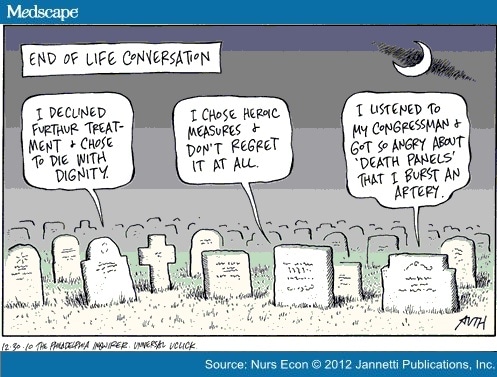

Figure 1.  


The Past

We both began our oncology nursing careers in the 1970s and witnessed at least three high-profile national debates on end-of-life issues (see Table 1). Each of these public debates gave us hope that sweeping and effective societal change toward end-of-life care would occur. The Patient Right to Self-Determination Act of 1990 (H.R. 4449) was passed in 1990 and implemented in 1991, requiring that patients be informed about advanced health care directives on admission to health care institutions. Although this may have been technically implemented, subsequent studies have shown the intent of this legislation has not been widely adopted. Sadly, this is not unusual when the letter of the law is implemented but the intent is missed. In 2010, while 61% of older Ameri cans feared outliving their savings more than they feared dying (Fleck, 2010), only 20%-30% of adult Americans reported having advanced directives (Sedensky, 2010).

Table 1. High-Profile Cases of Patients with Persistent Vegetative States

PatientYear of DeathBackground and Impact
Karen Ann Quinlan http://www.wired.com/science/discoveries/news/2008/06/dayintech_06111975 - 1985Parents requested removal of support machines after she was declared to be in a persistent vegetative state; physicians would not remove; parents took request to court and were supported. This was the first "right to die" case in U.S. legal history.
Nancy Cruzan http://www.libraryindex.com/pages/590/Court-End-Life-CASE-NANCY-CRUZAN.html1983 - 1990Parents requested removal of feeding tube; physi-cians agreed, but the Missouri state attorney general on behalf of the hospital took this to court; ulti-mately the Supreme Court upheld the Missouri Supreme Court's ruling to allow removal.
Patient Self-Determination Act. Proposed by Senator John Danforth (MO), passed into law by the U.S. Congress on October 26, 1990 and took effect on November 1, 1991.
Terri Shiavo http://www.nndb.com/people/435/0000263571990 - 2005After 10 years, husband asked to have the feeding tube removed; conflict between husband and her parents regarding her wishes as she had no writ-ten advanced directives; national attention as social conservatives objected to the removal think-ing it would set precedent for right-to-die movement.
Five years after her death, studies showed no increase in people who have written advanced directives.
Why the paradox? Why the heated debates about "death panels" in health care reform? We believe much of this is due to how our society deals, or doesn't, with death. Looking at the cancer population, we see findings that reflect aggressive, costly, and often ineffective care at end of life and limited engagement in palliative care and hospice services (see Table 2). We are bombarded with media stories of heroic end-of-life rescues that technology and skill have made possible. Yet, with the recent exceptions of Elizabeth Edwards, Randy Pausch, and Steve Jobs, the more heroic stories of quiet choices rarely get highprofile media attention.

Table 2. National Cancer End of Life Statistics (2003–2007)

% (10th-90th percentile)
Hospitalized last month of life61.3% (54.7%-65.6%)
Cancer patients in ICU/CCU last month of life23.7% (14.6%-31.1%)
Dying in hospital28.8% (20.1%-36.1%)
Enrolled in hospice month before death54.6% (42.8%-67.1%)
Hospice days in final month of life8.7 days (7.3–11.6)
Cancer patients receiving chemotherapy last 2 weeks of life6% (4.1%-8.3%)
Cancer patients receiving life-sustaining procedure last month of life9.2% (5.6%-12.2%)
Cancer patients seeing more than 10 different physicians during final 6 months of life46.2% (28/4%-56.5%)
SOURCE: Dartmouth Atlas of Health Care (2012).

The Present

The question, "Life at what cost?" has a myriad of answers depending on the circumstances. To the parents of a premature low birth weight infant, all too common in the United States, the answer may be "whatever it costs!" To the octogenarian with advanced cancer, the answer might be "enough is enough." In between those chronological endpoints are endless circumstantial variations due to age, the nature of disease, family, insurance coverage, personal financial and support resources, and spiritual beliefs. In all these scenarios, however, is the increasing question of the cost of care and the inequity in the United States of the "haves" and "have-nots." Those with insurance have options those without do not have. Even within the insured population, depending on the plan and co-payment responsibilities, options of care can vary widely. At the nexus of the financial and life crisis is the health care team, and it is often the nurse who is asked the difficult questions by the patient or the family in the middle of the night in the hospital, hospice, or skilled nursing facility.
The solution to the question, "How can we afford to die?" while enlightened by research, must ultimately be addressed through a discourse we have not yet had in the United States: What is our moral belief about health care, not about prolonging life at all cost? We must ask ourselves "life at what cost?" Research has already demonstrated the cost/benefit of end-of-life care provided outside the acute care setting (Brumley et al., 2007; Enguidanos, Cherin, & Brumley, 2005; McBride, Morton, Nichols, & van Stolk, 2011). Surveys have shown the majority of people do not want to die in hospitals, yet many do. Luckily, this trend is beginning to change (Gomes, Calanzani, & Higginson, 2012; Hansen, Tolle, & Martin, 2002; Wilson et al., 2009). Ultimately, the conversation must happen at the local, individual level. But nurses miss opportunities to initiate or facilitate these conversations (Boyd, Merkh, Rutledge, & Randall, 2011). Research can evaluate strategies for intervening with patients and families and for preparing health care professionals on how to initiate and conduct these critical conversations.

Difficult Conversations

When one denies that death is inevitable, talking about end-oflife wishes becomes a difficult and uncomfortable, and even surreal, conversation. How do you want to live your life in the last few years/months/weeks? Where do you want to live them? How do you want to be cared for? Mahon (2011) suggests asking two questions: "If you cannot, or choose not to participate in health care decisions, with whom should we speak?" and "If you cannot, or choose not to participate in decision making, what should we consider when making decisions about your care?"
This conversation is best initiated prior to needing the answers to these important questions and should be revisited periodically. We both have personal experiences with our own family members being more and less open to these discussions. We have cared for patients who are ready for these discussions and their families were not and vice versa. We also have witnessed when there is a discrepancy between patient and family and within the family to know when enough is enough. The consequences of a death when everyone is not on the same page can be that the family and providers are left with debilitating emotions of anger, guilt, or regret. Yet we have also witnessed the positive outcomes when patient, family, and providers are all on the same page. This is such a qualitatively better experience; one everyone deserves.
Why doesn't this happen more often? One reason may be that it requires frank conversations about values, beliefs, desires, and fears. These can be sensitive and time-consuming conversations that need to occur between the patient and family and between patient and health care provider. Yet Iezzoni, Rao, DesRoches, Vogeli, and Campbell (2012) found that more than half the physicians in their study admitted they had given a prognosis more positive than the facts supported. If a patient does not have an honest picture of the prognosis, a realistic conversation can't even begin about end-of-life care. When it does, concerns about the financial impact of endof- life care for the individual and his or her family, differences between patient and family wishes, and fears of abandonment from the health care provider can overshadow the quality-of-life desires of the individual. These conversations are difficult to conduct in a brief office or inpatient visit, especially if someone's health is deteriorating. However, studies have shown that patients are worried about these issues and want to talk about them (Wentlandt et al., 2011). Other barriers to effective counseling on end-of-life care include health care providers who are inadequately prepared to have these conversations, the fragmentation of care that individuals with multiple chronic illnesses receive, and lack of reimbursement for these discussions. The concept of a "medical home" may help address these barriers, but until outcomes of this structure are measured and disseminated, it remains just a concept.

The Future - Actions Nurses Can Take

To paraphrase Mohandas Gandhi, we must be the change we wish to see in our health care world. Thus, there are actions that nurses can take to educate themselves and others about the costs and options of end-of-life treatment and to advocate for death with dignity. Some actions are small, others grand, but nurses can and must engage in them.

Beginning With Ourselves

Nurses can start to answer the question of "How can we afford to die?" by asking themselves whe ther they have had these discussions with their own families and providers. A survey of oncologists indicates 40% of respondents did not (Schroeder et al., 2008). The likelihood is that a survey of oncology nurses would show similar results. Each nurse can take the following steps:
  • Complete your own advance directives and health care proxy.
  • Have discussions with family members about their wishes and communicate your own wishes.
  • Help family members complete advance directives and health care proxies if needed.

Starting the Conversation With Others (Education, Local to National)

Nurses have the unique trust relationship with the public that positions them as effective educators about end-of-life discussions and advocates for elevating this conversation locally and nationally. There are many approaches to educating the public.
  • Cipriano (2012) describes facilitating a discussion for her local hospice after the screening of the film, "Consider the Conversations: A Documentary on a Taboo Subject."
  • Presentations and discussions for church groups or at community service organizations are frequent venues where nurses can volunteer their expertise.
  • In this issue, Short (2012) references a challenge undertaken by DNP students to influence others to complete advance directives. Others can take up this challenge.

Advocating for Individuals, for Society

A fundamental role of nurses is to advocate for patients when needed, such as advocating for those who are not being heard by their health care provider or family. There are many other ways and places where nurses can advocate since they are at the interface of care and policy. Given the intent of The Patient Right to Self-Determination Act of 1990 has not been met, top-down legislation may not be the answer and a grassroots groundswell might achieve better results. Some considerations:
  • Politics are local and thus, nurses should use the local media to inform the community on the differences in prolonging life at all costs and dying with dignity.
  • Misinformation, such as in the "death panels" hysteria, needs to be corrected immediately and frequently.
  • Communication to legislators about proposed policies is easy given today's electronic connections.
  • Technologies for both improving the health of patients and supporting a dignified death need more extensive use and funding.

Preparing Our Profession to Have the Conversations

A recent study by White and Coyne (2011) reinforces the need for continuing education in end-of-life care and showed the second highest rated core competency needed by nurses is communicating about death and dying. Content can be developed to support nurses in gaining skill and confidence in their ability to discuss end-of-life decisions with patients or policy needs with legislators in every nursing degree and relevant continuing education program.
  • The curriculum offered by the Oncotalk® program can be accessed and adapted for student groups.
  • Experiences for health professions students focused on endof-life decisions begins the process of preparing future generations of care providers to collaborate on these complex issues.
  • The End-Of-Life Nursing Educa tion Consortium (ELNEC) is a program administered by City of Hope National Medical Center and the American Association of Colleges of Nursing (AACN) which was designed to enhance palliative care in nursing (AACN, 2012). Over 11,000 nurses representing all 50 states and 65 countries have received ELNEC training which they share with colleagues in educational and clinical settings. Enrollment information can be found at http://www.aacn.nche.edu/elnec

Answering Critical Questions

Research has shown the cost of care at the end of life as well as the public's preference not to die in hospitals. There are other critical questions to study, such as:
  • Identifying factors that inhibit or foster better end-of-life care.
  • Testing strategies for effectiveness in preparing health professions students to communicate with patients about end-of-life choices.
  • Evaluating what methods are most successful for introducing and having completed advanced directives.
  • Finding what interventions prevent hospitalization when crises occur at end of life.
  • Assessing approaches to less en caregiver burdens.

Administering Policies

Regulations about advanced directives vary by the setting; some organizations are required to ask about them. Regardless of the setting, nurse administrators could and should consider systems for ensuring patients' wishes are known. Obtaining this information should not be just another part of the patient's health history but go beyond just checking the question off a list. In developing a process, questions to answer include:
  • What happens if the patient says he or she has an advance directive/health proxy? Where are these wishes documented?
  • What happens if a patient doesn't have an advance directive/health proxy? Are there resources to assist the patient to complete an advanced directive?
  • What is the process to evaluate how well the information is documented in the patient's record?

Using Resources

There are abundant resources available to nurses on the Internet. Innu merable web sites offer access to advance directives forms tailored to state requirements. Professional organizations have resources specific for health care professionals as well as for the public. Two resources we find helpful are the Jewish Healthcare Foundation's Closure (2012) web site and The American Society of Clinical Oncology (2011) patient education booklet about advance directives.

Final Thoughts

Nurses have the honor of consistently being ranked as the most trusted professionals by the public (Gallup, 2012). This trust gives us an opportunity to raise the conversation about the most difficult of questions, "How can we afford to die?" In our death-adverse society, in which care at all cost continues to increase the overall cost of health care, this is a question that must be deliberated and answer ed. Top-down policies will not provide the solution. Nurses can advocate for death with dignity through local conversations, initiatives, and individual encounters and ignite this transformation. Every nurse can and must be part of leading this change.

Sidebar

Executive Summary

  • With a combined career of over 60 years in oncology nursing, the authors reflect on the critical elements in the question, "How can we afford to die?"
  • Three high-profile patient scenarios in three different decades promised to improve use of advance directives but did not.
  • Recent societal events, including the debates about health care reform, have brought attention again to end-of-life issues and care.
  • Quickly approaching a "perfect storm" of an aging population, an inefficient and costly illnessoriented health care system, and health care profession shortages, the United States will not be able to afford delivering futile interventions.
  • Nurses, who are consistently seen as the most trusted professionals, must take action in strategies the authors present.

References

  • American Association of Colleges of Nursing (AACN). (2012). ELNEC (end-of-life care). Retrieved from http://www.aacn.nche.edu/elnec
  • American Society of Clinical Oncology (2011). Advanced care planning. http://www.cancer.net/patient/Coping/Advanced%20Cancer%20Care%20Pla nning/Advanced_Cancer_Care_Plannin g.pdf
  • Boyd, D., Merkh, K., Rutledge, D., & Randall, V. (2011). Nurses' perceptions and experiences with end-of-life communication and care. Oncology Nursing Forum, 38(3), e229-e239.
  • Brumley, R., Enguidanos, S., Jamison, P., Seitz, R., Morgenstern, N., Saito, S., … Gonzalez, J. (2007). Increased satisfaction with care and lower costs: Results of a randomized trial of in-home palliative care. Journal of the American Geriatric Society, 55(7), 993–1000.
  • Cipriano, P. (2012). When it's my time to die. American Nurse Today, 7(1), 6.
  • Dartmouth Atlas of Health Care. (2012). Understanding of the efficiency and effectiveness of the health care system. Retrieved from http://www.dartmouthatlas.org
  • Enguidanos, S.M., Cherin, D., & Brumley, R. (2005). Home-based palliative care study: Site of death, and costs of medical care for patients with congestive heart failure, chronic obstructive pulmonary disease, and cancer. Journal of Social Work in End-of-Life and Palliative Care, 1(3), 37–56.
  • Fleck, C. (2010). Running out of money worse than death. Retrieved from http://www.aarp.org/work/retirement-planning/info-06–2010/run ning_out_of_money_worse_than_death. html
  • Gallup (2011). Honesty/ethics in professions. Retrieved from http://www.gallup.com/poll/1654/Honesty-Ethics-Professions.aspx
  • Gomes, B., Calanzani, N., & Higginson, I.J. (2012). Reversal of the British trends in place of death: Time series analysis 2004–2010. Palliative Medicine, 26(2), 102–107.
  • Hansen, S.M., Tolle, S.W., & Martin, D.P. (2002). Factors associated with lower rates of in-hospital death. Journal of Palliative Medicine, 5(5), 677–85
  • Iezzoni, L.I., Rao, S.R., DesRoches, C.M., Vogeli, C., & Campbell, E.G. (2012) Survey shows that at least some physicians are not always open or honest with patients. Health Affairs, 31(2), 383-391.
  • Jewish Healthcare Foundation. (2012). Closure. Retrieved from http://closure.Org
  • Mahon, M. (2011). An advance directive in two questions. Journal of Pain and Symptom Management, 41(4), 801–807.
  • McBride, T., Morton, A., Nichols, A., & van Stolk C. (2011). Comparing the costs of alternative models of end-of-life care. Journal of Palliative Care, 27(2), 126-133.
  • Schroeder, J.E., Mathiason, M.A., Meyer, C.M., Frisby, K.A., Williams, E., & Go, R.S. (2008). Advance directives (ADs) among members of the American Society of Clinical Oncology (ASCO). Journal of Clinical Oncology, 26 (Suppl.), abstract 20611.
  • Sedensky, M. (2010). 5 years after Schiavo, few make end-of-life plans. Retrieved from http://www.boston.com/news/nation/articles/2010/03/30/5_years_ after_schiavo_few_make_end_of_life_ plans
  • Short, N.M. (2012). The final frontier. Nursing Economic!, 39(3), 185–186.
  • Strokoff, S., & Grossman, E. (2010). Patient Protection and Affordable Care Act: Public Care Act: Public Law 111–148. http://housedocs.house.gov/energycommerce/ppacacon.pdf" http://housedocs.house.gov/energycommerce/ppacacon.pdf
  • Wentlandt, K., Burman, D., Swami, N., Hales, S., Rydall, A., Rodin, G, … Zimmerman C. (2011). Preparation for the end of life in patients with advanced cancer and association with communication with professional caregivers. Psycho-Oncology. doi:10. 1002/pon.1995. [Epub ahead of print]
  • White, K.R., & Coyne, P.J. (2011). Nurses' perceptions of educational gaps in delivering end-of-life care. Oncology Nursing Forum, 38(6), 711–717.
  • Wilson, D.M., Truman, C.D., Thomas, R., Fainsinger, R., Kovacs-Burns, K., Froggatt, K., & Justice, C. (2009). The rapidly changing location of death in Canada, 1994–2004. Social Science & Medicine, 68(10), 1752–1758.


-->

Tuesday, July 17, 2012

Walking Irregularities a Harbinger of Cognitive Decline?

Walking Irregularities a Harbinger of Cognitive Decline?

Caroline Cassels
July 15, 2012 (Vancouver, British Columbia) — Gait disturbances — including slowing of walking pace or variations in stride — may be an indicator of cognitive decline, new research suggests.
Four new studies presented here at the Alzheimer's Association International Conference (AAIC) 2012, suggest that observing and evaluating gait in older patients may be a valuable tool when trying to determine the need for further cognitive evaluation.
In the first study, investigators from the Basel Mobility Center in Basel, Switzerland, showed that gait speed slowed and became more variable as cognitive decline progressed.
"Small changes in variability, not visible to the naked eye, can be measured, and those small changes can have a heavy clinical impact," principal investigator Stephanie A. Bridenbaugh, MD, from the Basel Mobility Center, told reporters attending a press briefing.

Dr. Stephanie Bridenbaugh

For example, Dr. Bridenbaugh noted that a change in stride length of just 1.7 cm from one stride to the next can almost double the risk of an older person falling within the next 6 months.
Increased gait variability, she added, can also increase the risk for dementia within the next 5 years, so being able to detect walking irregularities before falls occur or before dementia develops is "relevant and important," she added.
To determine whether gait analysis may aid in the diagnosis of cognitive impairment, the investigators followed 1153 older men (average age, 77 years) who were outpatients at a memory clinic as well as a group of healthy control participants from 2007 to 2011.
Study participants were divided into 3 groups on the basis of their cognitive status. These included healthy cognition (n = 357), mild cognitive impairment (n = 309), or Alzheimer's dementia (AD) (n = 487).
Those with AD were further subdivided into mild (n = 219), moderate (n = 230), or severe (n = 38).
Gait was measured using a 10-meter-long electronic walkway with almost 30,000 integrated pressure sensors.
All participants performed 1 normal walk and 2 different dual tasks — normal walking (self-selected speed) or walking while simultaneously counting backwards out loud or naming animals.
The researchers found that gait slowed as cognitive impairment progressed. In addition, compared with healthy control participants, all cognitive groups' gait was slower during dual task vs normal walking.
Dual Tasking Key
Gait variability, said Dr. Bridenbaugh, remained relatively stable during the normal walking cycle task until AD was moderate or severe. But during dual tasking, gait variability was higher in all cognitive groups. In addition, variability worsened as dementia progressed.
It was noteworthy, she added, that if only gait had been measured during the single walking task, gait changes would not have been detected until the latter stages of cognitive impairment.
"Quantifying gait during dual tasking allows detection of increased abnormal gait variability already at the stages of mild cognitive impairment. So for me, the particularly interesting cases are the ones in which gait variability is abnormally increased during dual tasking but neuropsychological testing shows normal cognition," she said.
"Those are generally the cases where functional impairment preceded measurable cognitive impairment. and I think the situation should trigger a mental flag alerting us to impending problems with both gait and cognition," she said.
The study indicates that dual task paradigms can detect subtle gait differences that would not be picked up by a single walking task alone, she added.
Early Predictor?
Similarly, the Mayo Clinic Study of Aging (MCSA) showed that study participants with lower cadence, velocity, and amplitude of the stride length experienced significantly larger declines in global cognition, memory, and executive function.
Although previous research has examined gait abnormalities that may be associated with cognitive impairment and dementing illnesses, it is unclear which gait components may be associated with future cognitive decline.
"We observed an association between reduced gait velocity, cadence, and stride length and both global and domain-specific cognitive decline in our population. These results support a possible role of gait changes as an early predictor of cognitive impairment," study investigator Rodolfo Savica, MD, Mayo Clinic, Rochester, Minnesota, said in a release.

Dr. Rodolfo Savica

The MCSA measured stride length, cadence, and speed of more than 1341 study participants through a computerized gait instrument at 2 or more visits 15 months apart.
Outcomes included results on the Short Test of Mental Status (STMS) and results of assessment of 4 neurological and neuropsychological tests covering 4 domains that included memory, attention/executive function, language, and visuospatial ability.
In addition to memory, attention/executive function, language, and visuospatial ability, lower gait measures were significantly associated with a greater decline on the STMS.
Gait Training to Prevent Dementia
In a third study of 1232 individuals aged 49 years and older, investigators from the Rotterdam Study in the Netherlands found that specific aspects of gait are linked with specific cognitive abilities and function.
Specifically, researchers found that walking rhythm, which reflects walking stride time and cadence, was significantly associated with information processing speed; executive function was associated with walking pace and variability; and fine motor speed was associated with walking in tandem or heal to toe walking, in which the heel of the front foot is placed so as to directly touch the heel of the back foot, as though walking on a tightwire.
Memory, the researchers report, was not associated with any aspect of gait.
"These findings," said study investigator Mohammad Ikram, MD, PhD, from Erasmus MC, Rotterdam, "provides a better understanding of this full spectrum of brain dysfunction. It's not just general cognition and general gait; there is this subtle correlation between these various domains."

Dr. Mohammad Ikram

Against this background, said Dr. Ikram, future studies should explore the link between gait and dementia and AD.
"So can we use gait to predict Alzheimer's dementia before cognitive symptoms of dementia develop; and the reverse of that question is, can gait training be used to delay Alzheimer's dementia?" he said.
A Better Measure?
Finally, a study by researchers at Oregon Health & Science University in Portland suggests that continuous in-home monitoring may be a more accurate measure than single gait tests done, for example, at an annual physical examination.
Lisa Silbert, MD, and colleagues worked with 19 dementia-free volunteers enrolled in the Intelligent Systems for Assessment of Aging Changes (ISAAC) study.

Dr. Lisa Silbert

All participants underwent brain magnetic resonance imaging (MRI) to measure total brain volume and ventricular and hippocampal volumes. Gait speed was determined at the time of the MRI by assessing the time it took to walk 9 meters using a stopwatch and by using an in-home assessment system that continuously collected data over a 1-month period using motion activity sensors installed in the participants' homes.
The investigators found that study participants walked faster when measured once in person than when under continuous assessment in their home. They also found that slower walking speed was associated with smaller total brain size.
According to Dr. Silbert, walking speed taken at a single time point may overestimate walking abilities in the elderly.
Practical Implications
Commenting on the studies' findings for Medscape Medical News, William Thies, PhD, chief medical and scientific officer of the Alzheimer's Association, said that assessing gait is a practical tool that physicians can use as an early warning sign of dementia.

Dr. William Thies

"It gives [clinicians] another tool to pick out those people that they may want to have a conversation with about memory or that they want to refer for more intensive evaluation of their cognitive function," he said.
"We know how hard it is for the primary care doc to identify those people who are in the very early stages even of dementia. And so we think that this is something that will be useful to them and easy to build into their practice. It doesn't take a lot of time and doesn't cost anybody a lot of money. All of that seems attractive," said Dr. Thies.
The study authors and Dr. Thies have disclosed no relevant financial relationships.
Alzheimer's Association International Conference (AAIC) 2012. Abstract # O1-08-02, P1-073, P2-022, P2-169. All presented July 15, 2012.


-->

Millions of US Women Lack Adequate Healthcare

Millions of US Women Lack Adequate Healthcare

Troy Brown
June 13, 2012 — A new Commonwealth Fund report shows that women in the United States are in much worse shape, healthcare-wise, than women in 10 nations that have universal healthcare. Even insured American women are more likely to go without needed healthcare because of the cost and difficulty paying medical bills.
The report was published online July 13.
According to the report, the Affordable Care Act has brought coverage to millions of women already and is expected to improve women's healthcare in coming years.
The authors compared women's healthcare in the United States with that in 10 nations with universal healthcare: Australia, Canada, France, Germany, the Netherlands, New Zealand, Norway, Sweden, Switzerland, and the United Kingdom. "All other industrialized nations provide universal health insurance, generally with comprehensive benefits," the authors write.
The researchers used data from 3 surveys for their comparisons: the Commonwealth Fund International Health Policy Survey of Adults in Eleven Countries (2010), the Commonwealth Fund Biennial Health Insurance Survey (2003, 2007, 2010), and the March Annual Social and Economic Supplement to the Current Population Survey (2001 - 2011).
At a media teleconference held June 12, the report's authors described their findings and answered questions.
"We are on the cusp of a remarkable feat: providing comprehensive, affordable health insurance to almost all American women," Karen Davis, president of the Commonwealth Fund, explained. "It is crucial that state and federal policy makers and other key stakeholders actively work together to implement the reform law and take full advantage of all the benefits the Affordable Care Act offers so that all American families are able to benefit from the law's potential."
Ruth Robertson, MSc, a senior research associate for the Affordable Health Insurance program at the Commonwealth Fund explained, "Our focus on women is important because we know that women use more health services than men throughout their lifetimes, particularly during their reproductive years.
"They also have, on average, lower incomes than men, and this leaves them at greater risk of going without needed care because of its cost," she continued. "Women are also one of the groups that particularly benefit from the Affordable Care Act."
In 2010, 18.7 million women were uninsured, up from 12.8 million in 2000. In 2010, 16.7 million women were underinsured, up from 10.3 million in 2003.
Uninsured women in the United States were the most likely to have difficulty with medical bills and getting necessary healthcare, but even insured women in the United States were more likely to have these problems than women in the other 10 countries, according to the authors.
"Millions of women lack healthcare in the United States, but there are also an increasing number of women with health insurance who face such high out-of-pocket spending relative to their income, they are effectively uninsured," Robinson explained.
"From an international perspective, these high uninsured and underinsured rates in the United States are an exception," she added
Insured Women Hurting Too
The US women had the highest financial burden, with 43% of respondents reporting they had gone without needed care or failed to fill prescriptions because of cost in the past year. More than three fourths (77%) of US women who were uninsured during the year reported that they had foregone needed care. This was in sharp contrast to the other 10 countries, where that rate was no more than 28%.
The researchers found that after paying premiums, 39% of the US women spent $1000 or more out of pocket on healthcare in the past year compared with no more than 24% in the other 10 countries.
One quarter (26%) of the US women struggled to pay medical bills, more than twice the rate in 10 other countries. The proportion jumped to 51% among uninsured women.
Only half (52%) of US women were confident in their future ability to afford healthcare if they would become seriously ill. Most women in the United Kingdom (91%), the Netherlands (77%), and Switzerland (76%) felt confident about their ability to pay for future healthcare.
The authors write that a similar law implemented in Massachusetts in 2006 has been successful, with that state currently enjoying the lowest rate of uninsured in the country, at 5.3%.
"There are many provisions of the Affordable Care Act that specifically help women. Some are already helping women today," Robertson said. "Importantly for women, insurance companies will no longer be able to charge women higher premiums than men for identical policies, and all plans will be required to cover maternity care."
In 2011, 20.4 million women benefited from the Affordable Healthcare Act requirement that nongrandfathered insurance plans cover preventive care (such as screening for cervical, breast, and colon cancer; cholesterol checks; and osteoporosis and chlamydia screening without cost sharing) and provide direct access to obstetrics and gynecology services.
Medicaid now covers smoking cessation support for pregnant women and maternity care from free-standing birth centers, and firms with 50 or more employees are now required to provide new mothers with breaks to express breast milk.
Expanded Insurance and Medicaid Coverage
An estimated 6.6 million young adults aged 19 to 25 years remained on or joined their parents' health plans in 2011 who would probably not have been able to do so before the law; 3.1 million of them were women.
More than 2 million female Medicare recipients have saved $1.2 billion on prescription drugs because of the phase-out of the Medicare "donut hole," and 24.7 million women received preventive services without cost sharing.
Medicaid eligibility for adults was expanded in 7 states and the District of Columbia, covering an additional 600,000 people. The ban on insurers imposing lifetime benefits helped 39.5 million women, and the ban on rescissions helped another 5.5 million women.
Approximately 62,000 adults,(more than half women) enrolled in preexisting condition insurance plans. Such plans are available in all 50 states and are designed for individuals with health problems who have been without insurance for at least 6 months.
New subsidized insurance options will be available, including a significant expansion in Medicaid eligibility and premium tax credits for those with incomes up to $92,200 for a family of 4. This is expected to result in affordable, comprehensive coverage for nearly all women.
"The bottom line is that in 2014, women will no longer be disadvantaged in the insurance market and will have access to affordable, comprehensive health insurance. Insurers will no longer be able to vary insurance premiums by gender or health basis," said Robertson.
"This means that insurers will no longer be able to charge young women higher premiums than young men simply because of their gender. Insurers will also no longer be able to deny women coverage...because they've previously had a caesarean section or they've been a victim of domestic abuse," said Robertson.
Not everyone believes that the Affordable Care Act is the answer, however. J.D. Kleinke, a resident fellow at the American Enterprise Institute in Washington, DC, commented on the report in a telephone interview with Medscape Medical News.
"These women are going to get more benefits, but they're still being shoved into the existing system, with all its problems. Their copays aren't going to go away. Yes, there's preventive services and all that stuff, but this doesn't do anything about the out-of-control [cesarean delivery] rate, this doesn't do anything about ridiculously high copays, and other things that made the list," Kleinke said .
"This is better for women, but this is not health reform. This is health insurance market reform. They're very different things," Kleinke said.
"Oceans Apart: The Higher Health Costs of Women in the U.S. Compared to Other Nations, and How Reform Is Helping." Commonwealth Fund. Published online July 13, 2012. Full text


-->

Hospital Noise, Especially Alarms, Most Disruptive to Sleep

Hospital Noise, Especially Alarms, Most Disruptive to Sleep
Pauline Anderson
July 16, 2012 — A new study has quantified how disruptive typical hospital sounds are to the sleep of patients, and shows, perhaps not surprisingly, that electronic sounds that are intentionally alarming, such as phones and IV alarms, are more arousing than the sound of human voices, even at the same level.
Researchers report that sleep disruption is more likely during non-REM (rapid eye movement) stage 2 (the most abundant stage) than non-REM stage 3 (slow wave, the deepest stage). Arousal to sounds during REM sleep caused a greater and more sustained elevation in heart rate (HR), they also found.
These results point to the need for improved in-hospital acoustics to facilitate optimal care — something that will be increasingly in demand as the baby boomer generation ages and requires more institutional health services, the researchers suggest.
As it stands, surveys show that noise and bad sleep quality consistently top the list of complaints from hospitalized patients, said study author, Orfeu M. Buxton, PhD, assistant professor in the Division of Sleep Medicine, Harvard Medical School, and associate neuroscientist in the Department of Medicine, Brigham and Women's Hospital, Boston, Massachusetts.
"There's nothing quite as terrible as being sick or awaiting surgery or recovering and having to listen to someone else's TV or health issues being dealt with overnight," Dr. Buxton told Medscape Medical News.
Findings of this study were published online June 12 in the Annals of Internal Medicine.
Noise Stimuli
Disrupted sleep is associated with hypertension, cardiovascular and coronary heart disease, impaired immune function, elevated stress hormone responses, attention and memory deficits, and depressed mood.
For the study, researchers enrolled 12 healthy adults — 8 women, mean age 27 years, mean body mass index (BMI) 21.8 kg/m2. Study participants slept at home on a regular schedule for at least 4 days before the study.
For the 3-day investigation, participants stayed at the Massachusetts General Hospital Sleep Laboratory. During the first night, researchers verified the absence of sleep disorders and established baseline sleep recordings. On the next 2 nights, participants were exposed to various noises and noise levels while researchers documented electroencephalogram (EEG) arousals and electrocardiogram HR accelerations.
The protocol involved 14 noise stimuli, which included "good" conversation (voices discussing a positive patient outcome), "bad" conversation (the same voices discussing a negative patient outcome), door closing, telephone ringing, toilet flushing, ice machine dispensing, IV alarm going off, laundry cart rolling, jet roaring overhead, and traffic moving.
The sounds came from 4 overhead speakers placed about 7 feet from the bed. Once the patient was in a steady sleep stage, a 10-second sound was played — starting at the level of about a whisper and increasing by 5 decibels — until sleep was disrupted by an arousal, the sleep stage changed, or the maximum exposure level — about 70 decibels, or the equivalent of yelling — was reached.
"If the subject didn't have an arousal or changed stage or wake up, then we would wait 30 seconds, or 1 more epoch, and present another noise," said Dr. Buxton.
Louder Sounds
As expected, the study showed that louder sounds were more apt to cause sleep disruption. It also found that the most arousing noises were such things as a phone ringing and an IV alarm going off. Within the lowest tested ranges, these sounds produced sleep disruptions more than 50% of the time.
"We characterize those alarm noises as either intentionally alerting or intentionally obnoxious," said Dr. Buxton. In the real hospital environment, he said, such alarms often signal nothing more than the patient rolling over and accidentally setting off the bell.
"The amazing thing to me is that those sounds are so obnoxious that even when you control for the peak level of the sound, the peak decibel level in that 10 seconds, the intentionally obnoxious noises are still alerting even at the level of a whisper."
Conversations and voice paging were equally highly alerting. Sounds of ice machines and laundry carts were arousing at relatively low levels.
Sounds that come from outside the hospital — for example, jets taking off and street noises — were the least arousing among the stimuli, they found.
The researchers found unique arousal probability profiles for each sleep stage — REM, non-REM2 (or N2), and non-REM3 (or N3).
"What was really exciting for us was to see [that] at the level of speech, say 50 or 55 decibels across those 14 sounds, even controlling for the peak level, there's a huge dispersion in the arousal probability," said Dr. Buxton.
"If you look at deep sleep (non-REM3), phones and IV alarms will wake you up more than 90% of the time, voices will wake you 80% of the time, but the sounds of traffic are only disrupting sleep 10 or 15% of the time or less," Dr. Buxton added. "So there’s a 90% difference in the probability of arousal controlling for the peak of the sound. This suggests to us that the brain during non-REM is processing something about the content of the noise."
But when participants moved to REM sleep, that discrimination disappears, said Dr. Buxton. "There's much less dispersion in REM, as if you're no longer paying as much attention to the content" of the noises.
Cycle in Sleep
People cycle between REM and non-REM sleep about every 90 minutes, with REM sleep returning at the end of the sleep period, added Dr. Buxton. "So in the morning, we're relatively less able to discriminate amongst sounds and have a relatively low probability of arousal. A phone in the beginning of the night is more likely to wake you up than the same phone ringing in the morning."
Arousal effects of noise on sleep included HR elevations — even when disruptions were brief. The stage in which the arousal occurred substantially predicted the magnitude of the HR increase (P < .0001).
"We demonstrate that evoked arousals elicit HR acceleration from all stages of sleep, but a greater magnitude (10 beats/min) and faster onset of HR accelerations from REM, with lesser magnitude and less rapid accelerations in stages N2 and N3,” the authors write.
Baseline (pre-arousal) HR did not predict the magnitude of the response (P = .94). The study night was not significant (P = .83), reflecting lack of habituation of the electrocardiogram HR response, said the authors.
Heart rate effects might be particularly relevant to the critical care settings of a hospital. ICUs, said Dr. Buxton, "are the most heavily alarmed, panicked places, where everyone is hooked up to so many different things that can alarm at any one point." He noted that in real life, hospital patients are likely exposed to more than one noise at a time — and even more frequently than was the case in this study.
The researchers recommend greater focus on a protective sleep environment. Possible changes include designing more acoustically sound facilities, improving alerting technology (eg, central monitoring stations), providing less disruptive night care routines, and educating healthcare personnel on the negative effect of noise on patient health.
Such measures do work. Dr. Buxton cited one study showing that demand for sedative medications was reduced by 49% (P = .0041) and by 62% in patients over 64 years of age (P = .005) through such steps as putting ice machines behind closed doors, playing a lullaby in the evening, dimming the lights, installing a sound meter in the hallways and alerting staff when their voices were raised, and doing medication checks at the same time.
Informative Study
Invited to comment, Michael Decker, PhD, associate professor at Georgia State University, Atlanta, Georgia, and spokesperson for the American Academy of Sleep Medicine, said he found the study design intriguing and the results informative with regard to the physical impact of sleep disruption.
"If we are chronically interrupted throughout the night by noise and our heart rate is accelerated and our blood pressure shoots up, that is not necessarily a good thing for the healing process," he said.
"Intuitively, we've known that loud noise is bad for patients trying to sleep, but I think this is one of the first studies to define just how bad it can be."
The impact of in-hospital sleep deprivation may be more severe in older patients, said Dr. Decker. He noted that the amount of slow wave sleep (non-REM3) decreases with age, and that older patients are much more vulnerable to being aroused by environmental noises.
Dr. Decker pointed out that systems that are designed to help keep patients safe at night — IV monitors and heart rate alarms — are the same systems that wake them up from sleep and can impair the sleep process. "We have to think about how to design alarms and how to alert medical staff to problems" while being minimally disruptive, he said.
Ann Intern Med. Published online June 12, 2012. Abstract


-->

Thursday, July 12, 2012

Intergenerational Project Creates Friendships

Intergenerational Project Creates Friendships

Crystal Waters Retirement Community in Strongsville, Ohio, already had intergenerational programs in place, but the community’s director, Stephanie Chambers, wanted a different kind of intergenerational program: “One that makes our residents feel that they matter and that they are important,” she says.

After conducting some research on the Ohio Department of Education academic standards for second grade social studies, Chambers had an idea. She contacted the school district’s Talent and Development Coordinator Libby Davis and invited her to tour the community. Davis accepted the invitation.

After lunch, Davis said, “I have a teacher and a second grade class for you.” The teacher was Mary Whitcar, who taught a class of gifted and talented students at Drake Elementary School located about 15 minutes away.

Whitecar and Chambers developed a curriculum that fit Chambers’ idea and met Ohio’s education standards. The result was four, four-hour weekly sessions at Crystal Waters.

Students would ask residents biographical questions such as: “What was your childhood like?” and “Did you have a pet?” Then the students would write the residents’ answers in a booklet and write out their own responses to the same questions.

Through discussions between resident and second grader, the students learned about history.

Now, the “The Story of Our Lives: A Biographical Journey” program was set to begin.

Finally, the day arrived for the children to come to Crystal Waters, and when Chambers saw the school bus full of children, she thought, “My dream is coming true.”

Chambers, staff, and residents were prepared to introduce the children to the residents through a series of get-to-know you games. But the children didn’t need the games; they warmed up to the residents instantly.
Each child was paired with a resident who had similar interests. For example, a girl who was taking piano lessons was paired up with a resident who had been a well-known piano teacher in the area.

The students began collecting biographical information from the residents, and while the answers were generationally different, the students and seniors discovered some commonalities, such as a love for pets or enjoyment in playing games.

The bonds between the second graders and the residents grew stronger as time progressed. They greeted each other with hugs and kisses and often said “I love you,” says Chambers.

The friendships continued after the program finished. Some children continue to visit the residents. The girl who played piano arrived at Crystal Waters on Easter Sunday with an Easter lily to visit the piano-teacher resident. Chambers explains that the resident did not have children of her own, but when the child showed up with the Easter plant for her, there wasn’t a dry eye among the witnesses, says Chambers. After receiving the lily, the piano teacher told Chambers, “This makes me feel young again.”

Tablet Computer May Interfere With Shunt Valve Settings

Janis C. Kelly
July 10, 2012 — Researchers are reporting that proximity to a tablet computer can interfere with settings of magnetically programmable shunt devices, which are often used to treat children with hydrocephalus.
The Apple iPad 2 (Apple Inc.) contains magnets that can change valve settings in the shunt if it is held too close to the valve — within about 2 inches.
Such a change may result in shunt malfunction until the problem is recognized and the valve is readjusted to the proper setting. Patients and their caregivers should monitor use of the tablet computer to ensure that no change is made to the valve settings, researchers say.
Cormac O. Maher, MD, a pediatric neurosurgeon and senior author of the report, said he hopes to raise awareness of this potential interaction through publication of this study.
This is not to say that the iPad 2 cannot be used safely in the vicinity of patients with programmable shunts, they write. "With proper precautions to keep a tablet device away from close proximity to the valve, the continued use of these devices, even in the general vicinity of patients with programmable shunt valves, appears to be safe," they conclude.
A variety of magnets can be found in households today, and the authors state that the magnetic field strength of the iPad 2 lies within the range of these everyday magnets. Patients and caregivers should regard precautions surrounding use of the iPad 2 to be the same as those taken with other household magnets.
These results were published online June 26, and appear in the August issue of the Journal of Neurosurgery: Pediatrics.
Shunt Malfunction
Researchers initiated the study after a tablet computer seemed to affect a programmable shunt in one of their patients, a 4-month-old girl with hydrocephalus.
Three weeks after the baby received the shunt, she was examined for shunt malfunction due to a changed setting in the magnetically programmable valve that regulates the flow of cerebrospinal fluid. The baby's mother stated that she had held an iPad 2 while holding the infant.
Programmable shunt valve settings can be altered by exposure to magnetic fields. Indeed, specialized magnets are used by physicians to adjust the settings on these valves. Because in this case no other environmental factor could be identified that would have led to a shift in the valve settings, the authors decided to test whether the iPad 2 might be implicated. Unlike the initial iPad, the iPad 2 contains several magnets and is often used with an Apple Smart Cover, which contains additional magnets.
The researchers tested 10 programmable shunt valves with a variety of settings. They exposed the valves to an iPad 2 with and without the Smart Cover at different distances: less than 1 centimeter (cm), 1 to 2.5 cm, 2.5 to 5 cm, 5 to 10 cm, and greater than 10 cm. Each exposure lasted 10 seconds.
Overall, the valves were tested 100 times for each of the 5 distances during exposures to the iPad 2 with the Smart Cover closed, and 30 times for distances less than 1 cm for the tablet computer without the cover.
After exposure of the programmable valves to the iPad 2 and Smart Cover at distances of 0 to 1 cm, researchers found that the settings had changed in 58% of the valves. After exposure at distances of 1 to 2.5 cm, the settings had changed in 5% of the valves, and after exposure at distances of 2.5 to 5 cm, the settings had changed in only 1% of the valves.
No changes in valve settings were identified after exposures at higher distances.
After exposure of programmable valves to the iPad 2 without a cover, which was tested only at distances of 0 to 1 cm, researchers found that the settings had changed in 67% of the valves.
Although no change in setting was found past a distance of 5 cm (2 inches), the authors caution that patients and caregivers should be made aware of the potential for a change in the settings of a magnetically programmable shunt valve if an iPad 2 is placed very near.
The authors have disclosed no relevant financial relationships concerning the materials or methods used in this study or the findings specified in this paper.
Journal of Neurosurgery: Pediatrics.2012;10:118-120. Published online June 26, 2012. Abstract.

Tablet Computer May Interfere With Shunt Valve Settings

Janis C. Kelly
July 10, 2012 — Researchers are reporting that proximity to a tablet computer can interfere with settings of magnetically programmable shunt devices, which are often used to treat children with hydrocephalus.
The Apple iPad 2 (Apple Inc.) contains magnets that can change valve settings in the shunt if it is held too close to the valve — within about 2 inches.
Such a change may result in shunt malfunction until the problem is recognized and the valve is readjusted to the proper setting. Patients and their caregivers should monitor use of the tablet computer to ensure that no change is made to the valve settings, researchers say.
Cormac O. Maher, MD, a pediatric neurosurgeon and senior author of the report, said he hopes to raise awareness of this potential interaction through publication of this study.
This is not to say that the iPad 2 cannot be used safely in the vicinity of patients with programmable shunts, they write. "With proper precautions to keep a tablet device away from close proximity to the valve, the continued use of these devices, even in the general vicinity of patients with programmable shunt valves, appears to be safe," they conclude.
A variety of magnets can be found in households today, and the authors state that the magnetic field strength of the iPad 2 lies within the range of these everyday magnets. Patients and caregivers should regard precautions surrounding use of the iPad 2 to be the same as those taken with other household magnets.
These results were published online June 26, and appear in the August issue of the Journal of Neurosurgery: Pediatrics.
Shunt Malfunction
Researchers initiated the study after a tablet computer seemed to affect a programmable shunt in one of their patients, a 4-month-old girl with hydrocephalus.
Three weeks after the baby received the shunt, she was examined for shunt malfunction due to a changed setting in the magnetically programmable valve that regulates the flow of cerebrospinal fluid. The baby's mother stated that she had held an iPad 2 while holding the infant.
Programmable shunt valve settings can be altered by exposure to magnetic fields. Indeed, specialized magnets are used by physicians to adjust the settings on these valves. Because in this case no other environmental factor could be identified that would have led to a shift in the valve settings, the authors decided to test whether the iPad 2 might be implicated. Unlike the initial iPad, the iPad 2 contains several magnets and is often used with an Apple Smart Cover, which contains additional magnets.
The researchers tested 10 programmable shunt valves with a variety of settings. They exposed the valves to an iPad 2 with and without the Smart Cover at different distances: less than 1 centimeter (cm), 1 to 2.5 cm, 2.5 to 5 cm, 5 to 10 cm, and greater than 10 cm. Each exposure lasted 10 seconds.
Overall, the valves were tested 100 times for each of the 5 distances during exposures to the iPad 2 with the Smart Cover closed, and 30 times for distances less than 1 cm for the tablet computer without the cover.
After exposure of the programmable valves to the iPad 2 and Smart Cover at distances of 0 to 1 cm, researchers found that the settings had changed in 58% of the valves. After exposure at distances of 1 to 2.5 cm, the settings had changed in 5% of the valves, and after exposure at distances of 2.5 to 5 cm, the settings had changed in only 1% of the valves.
No changes in valve settings were identified after exposures at higher distances.
After exposure of programmable valves to the iPad 2 without a cover, which was tested only at distances of 0 to 1 cm, researchers found that the settings had changed in 67% of the valves.
Although no change in setting was found past a distance of 5 cm (2 inches), the authors caution that patients and caregivers should be made aware of the potential for a change in the settings of a magnetically programmable shunt valve if an iPad 2 is placed very near.
The authors have disclosed no relevant financial relationships concerning the materials or methods used in this study or the findings specified in this paper.
Journal of Neurosurgery: Pediatrics.2012;10:118-120. Published online June 26, 2012. Abstract.